
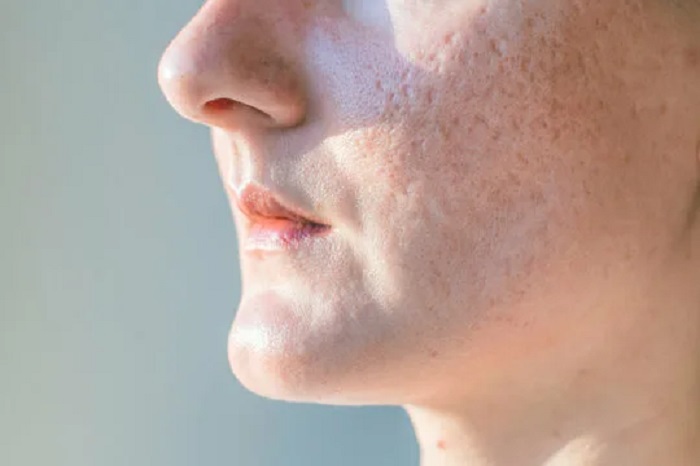
Why is that spot still on your cheek after eight months of a brightening serum? Usually because it was never a spot. Flat brown or red marks left behind by a breakout do fade on their own over months, while a dent or a pit will not, because tissue has actually been lost, and no serum rebuilds structure. Once you land on that side of the line, the useful options are the ones that stimulate collagen, which is what a treatment like procell microchanneling in Fort Worth is built to do.
This distinction costs people years. Someone finishes a course of acne treatment in their twenties, sees what looks like leftover damage, and starts a decade of serums aimed at colour when the actual problem is texture. The good news is that the two are easy to tell apart once you know the test, and you can run it tonight in your own bathroom.
How can you tell a scar from a mark?
Turn off the overhead light and hold a lamp or a phone torch to the side of your face, almost flat against the skin. Flat pigment disappears in side lighting. Texture throws a shadow. That shadow is the whole diagnosis, and it takes about two minutes.
What the two categories look like in practice:
- Post-inflammatory hyperpigmentation. Flat brown or grey-brown patches where a spot used to be. Smooth to the fingertip. Fades gradually with sun protection, and faster with exfoliating acids or professional peels.
- Post-inflammatory erythema. Flat pink or red marks, common on lighter skin. Also smooth, also temporary, though it can linger for a year.
- Ice pick scars. Narrow, deep, steep-sided pits that look like a puncture. The hardest category to improve.
- Boxcar scars. Wider depressions with defined edges, often on the cheeks and temples.
- Rolling scars. Shallow, wavy undulations with soft edges, most visible when the light is low and to the side.
The first two fade. The last three are structural, and they respond to collagen stimulation rather than to anything applied at home. The Skin Glow studio sits at 9705 Tehama Ridge Pkwy, Fort Worth, TX 76177, suite 101, and every scar consultation there opens with exactly this sort of assessment, because the treatment plan for pigment and the plan for texture share almost nothing. Booking the wrong one is how people conclude that nothing works. Anyone weighing options can compare protocols at med spa Skin Glow before committing to a course.
Why does skincare stop working on acne scars?
Topical products act on the epidermis and the very top of the dermis. Retinoids speed cell turnover, vitamin C interferes with pigment production, acids remove dead surface layers. All of that is genuinely useful against discolouration, and none of it reaches deep enough to rebuild a collagen deficit sitting well below the surface.
An atrophic scar forms when inflammation destroys collagen faster than the skin can lay it down, leaving a depression. Refilling that depression requires new collagen in the dermis, which means the skin has to be prompted to build it. Microchannelling does this by creating controlled micro-injuries: fine needles enter at a fixed depth, the skin registers a wound that is not really a wound, and the repair response deposits fresh collagen and elastin. Growth factor serums applied during the session support that process.
Evidence here is reasonably solid for an aesthetic treatment. A systematic review of randomised controlled trials published in the International Wound Journal in 2021 examined nine trials of microneedling for atrophic acne scars and found it consistently effective, whether used alone or combined with other approaches, with no serious adverse effects reported across the studies.
How many sessions before anything changes?
Plan on three to six sessions for post-acne scarring, spaced several weeks apart, regardless of your age. Collagen deposition is slow by design, so the visible change tends to arrive after the third or fourth appointment rather than the first, and it keeps developing for months after the course ends.
Two practical notes that save disappointment. First, the honest goal is improvement in appearance, not erasure: deep ice pick scars soften rather than disappear, and a good provider will say so at the consultation instead of after the deposit. Second, timing matters more than people expect. A course started in autumn runs through the months when sun exposure is easiest to control, which suits skin that has to stay protected between sessions.
Active breakouts change the plan entirely. Microchannelling is not performed over inflammatory acne, so the sequence is to settle the acne first, then treat what it left behind. That order feels slow. It is still faster than another eight months of the wrong serum.